
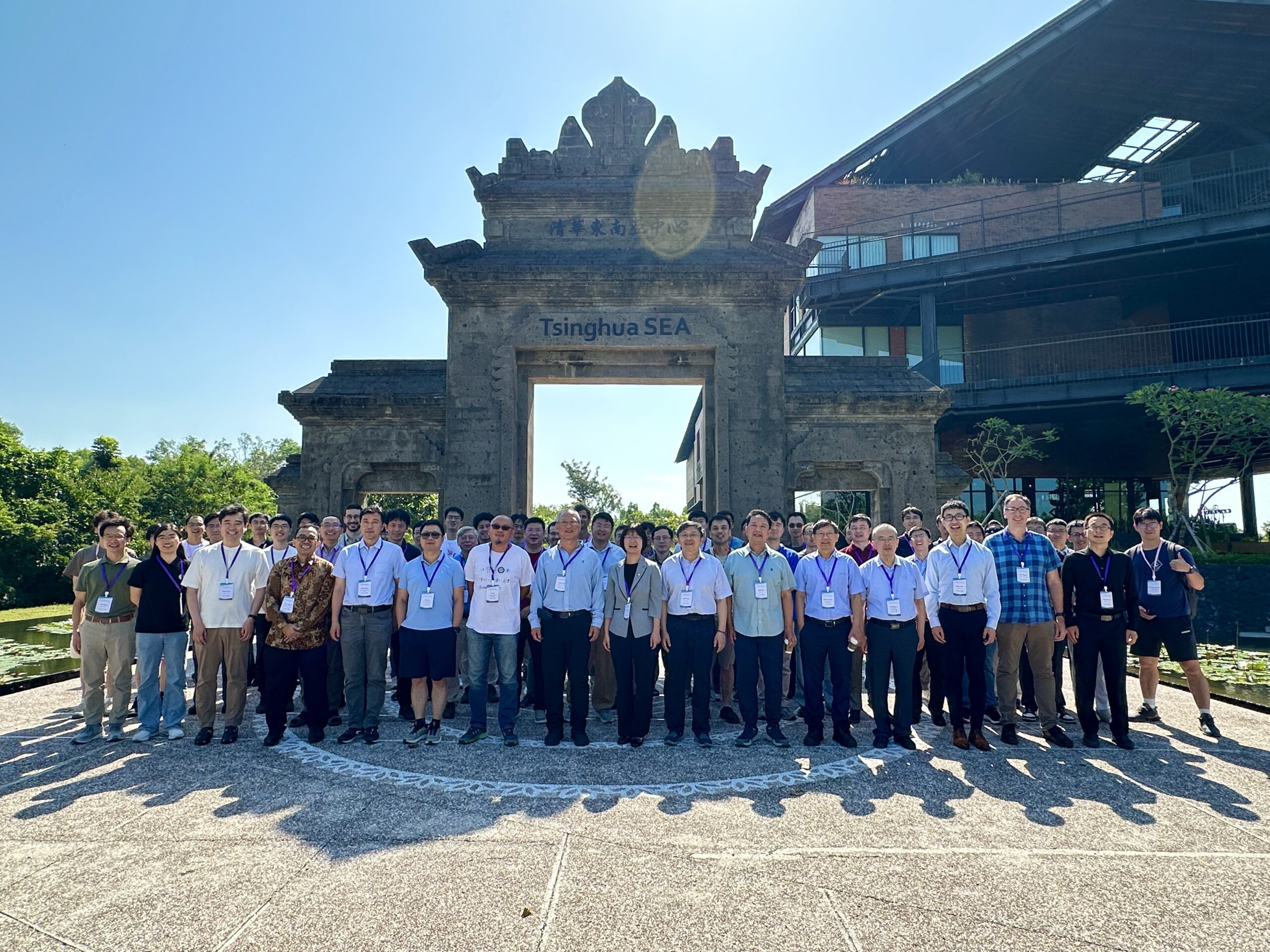
16-20 June 2025 – Tsinghua SEA, Bali
From June 16–20, 2025, leading researchers from around the world gathered at the Tsinghua Southeast Asia Center’s Awan Auditorium for an intensive five-day exploration into the frontier of light–matter interactions, titled Light-Induced Emergent Phenomena in Low-Dimensional Materials. The opening sessions began with in-depth theoretical discussions on symmetry-related phenomena and transitioned to advanced applications in magnetic materials, topological physics, and quantum devices. Presentations showcased groundbreaking advances, including light-induced exciton supersolids, momentum-space exciton mapping, and quantum two-dimensional coherent microscopy. These advances demonstrate the connections between fundamental theory and cutting-edge experimentation.
The midweek sessions delved into ultrafast optics, terahertz science, and attosecond physics. These sessions offered unprecedented insights into the fastest processes in condensed matter systems. Researchers demonstrated how to harness terahertz magnetic fields, Floquet optical selection rules, and non-perturbative topological optics to manipulate quantum states with exquisite precision. Studies employing real-time density functional theory, cavity electrodynamics, and nonequilibrium electron-phonon dynamics unveiled novel approaches to guide materials into exotic quantum states, where structural, electronic, and magnetic properties converge. These sessions underscored the rapid evolution of a toolkit for engineering matter at the quantum level, paving the way for fundamental research and technological innovation.
As the program progressed, the focus shifted to lightwave-driven phenomena, superconducting systems, and ultrafast electron imaging. Using subcycle time-resolved ARPES and momentum microscopy, scientists captured transient behaviors in kagome superconductors, topological insulators, and graphene with unparalleled clarity. Investigations into nonlinear responses in magnetic topological insulators, the superconducting diode effect, and metastable states in charge-density-wave materials highlighted the variety of emergent phenomena that can be explored using ultrafast optical techniques. Participants also enjoyed cultural activities such as island tours, turtle releases, and visits to local heritage sites, which fostered informal exchanges and collaboration.
On the final day, the focus returned to the future of 2D materials and their potential applications in quantum technologies. Discussions on quantum light sources, many-body effects in exciton dynamics, and novel nonlinear optical responses highlighted the potential of these systems for next-generation quantum communication and computation. The closing remarks celebrated the conference as a milestone in bridging theory, experimentation, and application in quantum materials research. Even with late-breaking contributions still to come, Light-Induced Emergent Phenomena in Low-Dimensional Materials reaffirmed that the intersection of light and low-dimensional systems is one of the most dynamic and transformative frontiers in science.