
About CIWCW 2026
The 2nd International Conference on Indigenous Wisdom in the Contemporary World (CIWCW) will be held on 4 September 2026. Themed “The Future in Balance: AI, Humanity, and Sustainability Aligned with Tri Hita Karana,” the 2026 conference continues the exploration of how indigenous wisdom can inform and guide solutions to contemporary global challenges—this time focusing on the ethical and sustainable development of artificial intelligence (AI).
With Bali as a real-time example of indigenous wisdom in practice and Tsinghua SEA as a hub for innovation and dialogue, the conference will feature a plenary session with keynote speeches and panel discussions that highlight the importance of Tri Hita Karana as a guide for developing sustainable AI, while promoting inclusiveness and guaranteeing sovereignty over data and AI ownership. The conference will also highlight groundbreaking research from leading global scholars on the potential for Tri Hita Karana to contribute to the ethical development of sustainable AI, where AI systems are designed, governed, and leveraged in ways that uphold cultural integrity, social well-being, and economic independence.
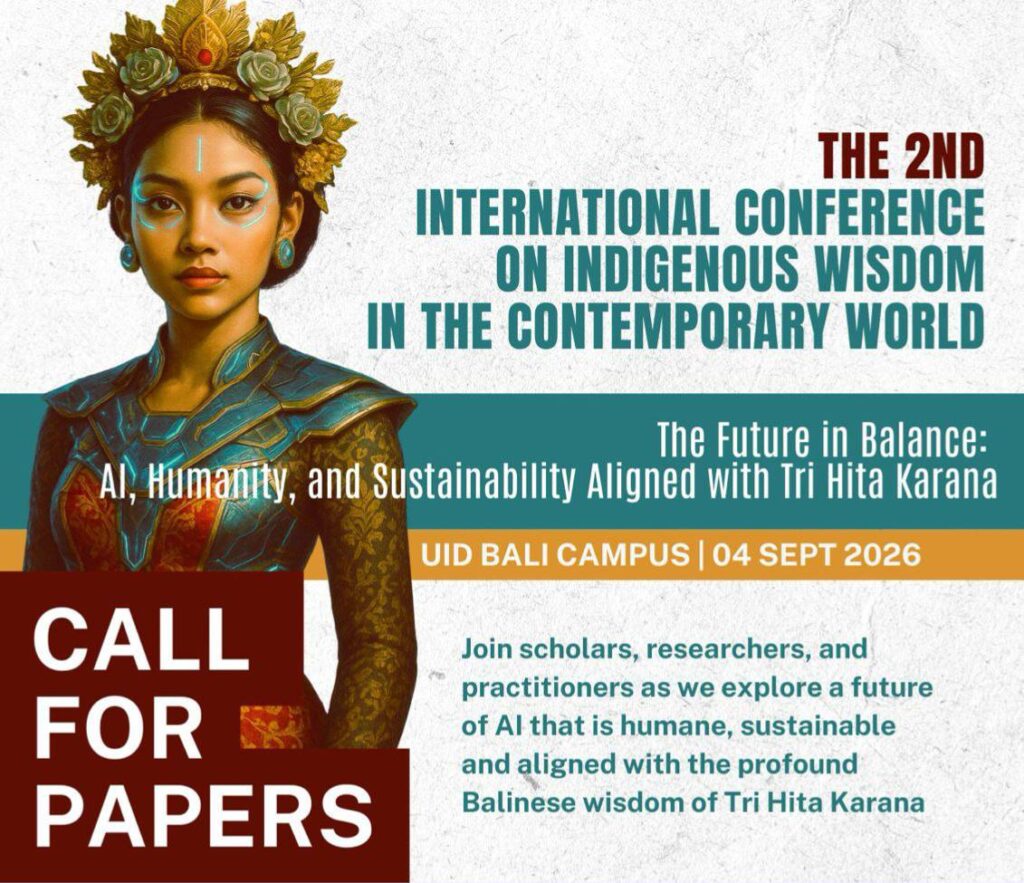
Conference Date & Location
Thursday, 4 September 2025
UID Bali Campus, Kura-Kura SEZ, Serangan, Bali
Conference Sub-themes
| Sovereign AI for Entrepreneurship | AI and The Future of Work and Talent |
| AI for Holistic Well-being and Health | AI for the Preservation and Revitalization of Indigenous Languages, Customs, and Heritage |
| AI for Sustainable and Regenerative Land and Ocean Management | AI and Historic Urban Landscapes and Cities |
| AI and Inclusive Sustainable Development | Sovereign and Democratic AI governance |
| AI for Cybersecurity | THK Human-Based Awareness Technologies and Methodologies for Algo-ethics: Ethical and Respectful AI |
Important Dates:
| Paper Submissions Open | 23 October 2025 |
| Abstract submission deadline | 1 May 2026 |
| Acceptance announcement | 1 June 2026 |
| Registration deadline for presenters | 1 August 2026 |
| The The 2026 Conference Indigenous Wisdom in the Contemporary World | 4 September 2026 |
Submission Guidelines:
The length of the abstract is approximately 250 – 500 words.
Abstract Title: [20 words maximum]
Font: Times New Roman, 14 pt, Bold, Center-aligned
Author(s): Name(s) of author(s), each followed by their institutional affiliation and email.
Font: Times New Roman, 12 pt, Center-aligned
Abstract
Font: Times New Roman, 12 pt, justified
This abstract should contain the following five key elements:
Purpose/Aims – Clearly state the main goal or objective of your research, explaining what you aim to achieve.
Design/Methodology/Approach – Provide a brief description of the research design, methods, or approach used to conduct the study.
Findings – Summarize the main findings or results of your research.
Originality/Novelty – Emphasize what makes your research unique or different from existing studies in the field.
Value/Contribution – Explain the importance and implications of your findings and how they contribute to the field or society.
Keywords: 4-6 keywords, separated by commas.
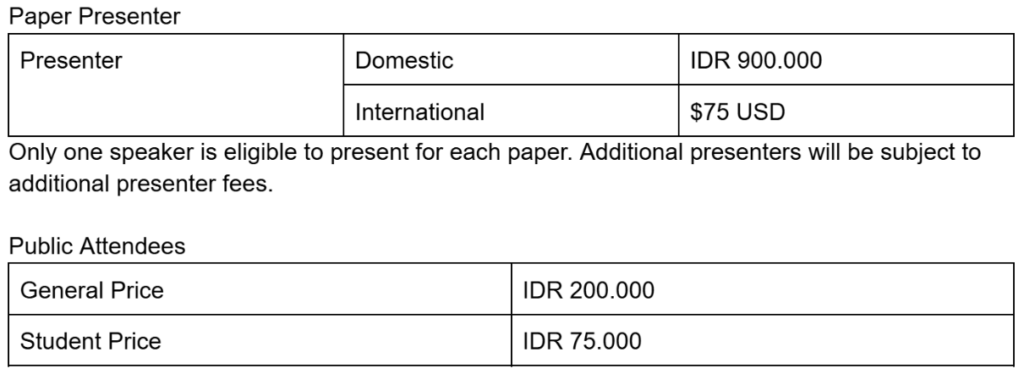
Pricing
About the organizers
Tsinghua Southeast Asia Center
The Tsinghua Southeast Asia Center (Tsinghua SEA) is a collaborative initiative between Tsinghua University and the United in Diversity Foundation, launched in 2018 and located at the UID Bali Campus. TSEA is dedicated to talent development, research, innovation, and academic exchange in Indonesia, Southeast Asia, and globally. The center takes a cross-disciplinary and multi-stakeholder approach, working in collaboration with industry, government, academia, and civil society in pursuit of advancing the United Nations Sustainable Development Goals. https://tsea.asia/
Fakultas Ilmu Budaya Universitas Udayana
Fakultas Ilmu Budaya (Faculty of Humanities) is the oldest faculty at Universitas Udayana, established even before the university itself was founded. When it was inaugurated by President Sukarno on September 29, 1958, it was originally known as the Faculty of Literature and was part of Airlangga University, East Java. After the establishment of three additional faculties, the government officially founded Udayana University on August 17, 1962.
The Faculty of Literature later became one of the founding faculties of Udayana University and underwent several name changes before becoming what is now known as the Faculty of Humanities. The faculty currently offers 12 study programs, including Balinese Literature, Old Javanese Literature, Indonesian Literature, English Literature, and Japanese Literature, as well as Archaeology, Anthropology, and History. Additionally, it provides two master’s programs (Master in Linguistics and Master in Cultural Studies) and two doctoral programs (Doctorate in Linguistics and Doctorate in Cultural Studies). The faculty attracts students from various regions across Indonesia and internationally.
https://www.unud.ac.id/in/fakultas1-Fakultas%20Ilmu%20Budaya.html